
Playwright: Write Reliable Browser Tests for an AI Feature
Test a real browser workflow using stable locators, deterministic test data, and assertions that reflect user-visible behavior.
Learning objectives
- Choose stable locators for an end-to-end test
- Separate deterministic UI checks from AI output evaluation
- Produce failure evidence that a developer can reproduce
ToolDix original visual
Frame
Name the outcome and constraints.
Build
Try one bounded workflow.
Review
Keep evidence, revise, and share.
Test the contract, not the model prose
For an AI feature, browser tests should verify login, input handling, loading state, safe error behavior, citations, exports, and access controls. Keep model-quality evaluation in a separate dataset-driven suite so a wording change does not make the user workflow flaky.
Build a stable scenario
Seed a known user and known input. Locate elements by role, label, or a dedicated test id. Assert visible behavior: the submit button becomes disabled while pending, an error message is announced when the request fails, and generated output has the expected structural fields.
Capture useful evidence
On failure, preserve a screenshot, trace, current URL, and concise console errors. Do not record production secrets or customer prompts. A failure artifact should help a teammate reproduce the issue without access to your private browser session.
Practice: one protected workflow
Create a test for a feature that requires a signed-in user. Verify an anonymous user is redirected, an authorized user sees the form, invalid input is rejected locally, and a simulated server failure produces a useful recovery message.
Common mistake
Do not use fixed sleep delays as success criteria. Wait for a concrete visible or network-backed state instead.
Sources and license context
These references informed the lesson. ToolDix adds its own explanation, workflow, and practice rather than reproducing source material.
- Playwright Documentation (Apache-2.0 documentation and repository terms)
Take it further
Use a primary source to deepen this lesson.
Each recommendation is a direct link to the publisher or author. The study prompt is ToolDix editorial guidance, not copied course content.
Video series
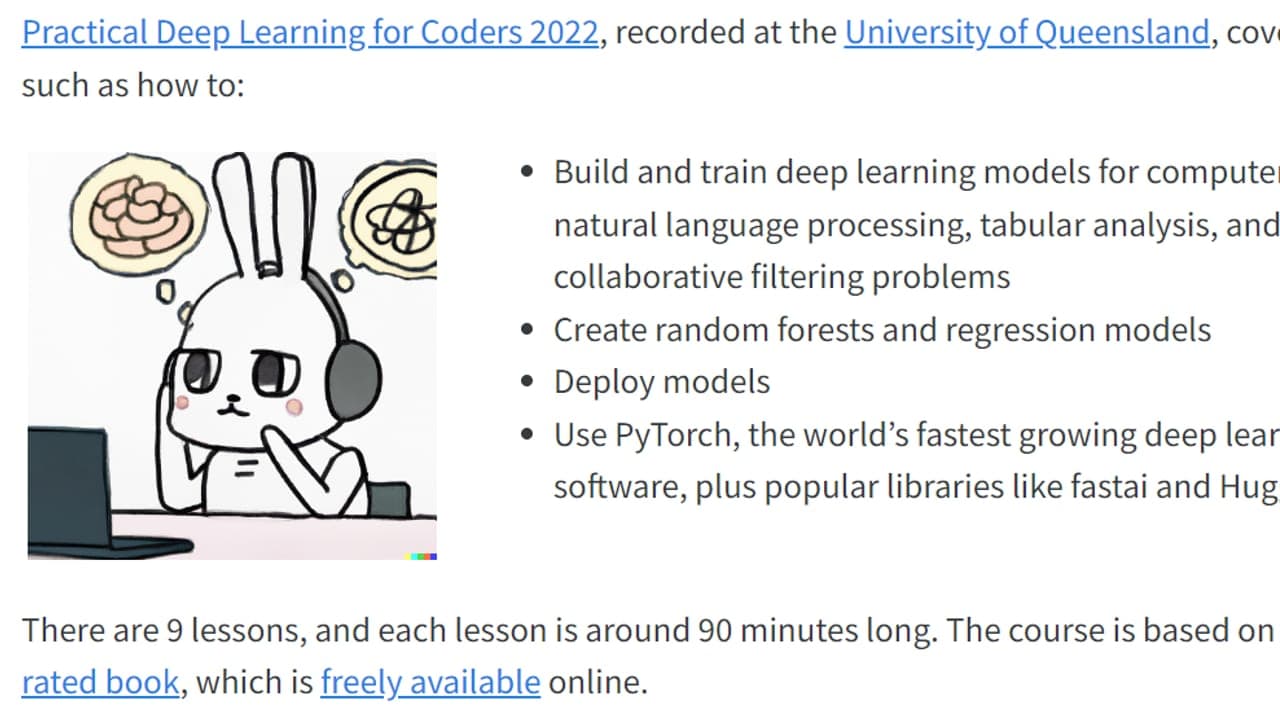
Practical Deep Learning for Coders
Watch lesson one with a notebook open; pause to reproduce one result rather than only taking notes.
Open original source
Hands-on lab
OpenAI Cookbook
Choose one recipe that matches your real input format and add an evaluation case before adapting it.
Open original source
Course
GitHub Copilot documentation
Write a small task description and a repository-specific acceptance check before asking an assistant to change code.
Open original source