Browse 20 learning paths

AI learning path

Machine Learning & Deep Learning

Learn the model, data, optimization, and evaluation foundations behind modern AI by training and inspecting small systems yourself.

For Developers, data practitioners, and technical beginners

24 original lessons on ToolDix, roughly 713 minutes end to end

Start the course

Course outline

  1. 1Build a Defensible Machine-Learning BaselineDefine a measurable task, create a leakage-resistant split, and compare a simple baseline before tuning a complex model.Beginner45 min
  2. 2Train, Diagnose, and Improve a Small ModelTrace tensors, loss, validation behavior, and error slices through a complete training loop before scaling compute.Intermediate50 min
  3. 3Supervised, Unsupervised, and Reinforcement LearningUnderstand the three core paradigms of machine learning and when to use each.Beginner28 min
  4. 4Linear Regression: Fitting a Line to DataLearn the mechanics of least-squares fitting, interpret coefficients, and evaluate regression models with real Python examples.Beginner28 min
  5. 5Classification and Decision BoundariesUnderstand how classifiers define decision boundaries, when complexity causes overfitting, and how to read a confusion matrix.Beginner30 min
  6. 6Ensemble Methods: Bagging, Boosting, and StackingCombine multiple models to reduce variance and improve robustness through three core ensemble strategies.Intermediate32 min
  7. 7Feature Engineering Before the Model Ever Sees DataMaster practical feature engineering techniques including encoding, scaling, handling missing values, and feature selection while avoiding data leakage.Intermediate28 min
  8. 8Regularization: Fighting OverfittingLearn L1 and L2 regularization, dropout, and early stopping to prevent overfitting and improve generalization.Intermediate26 min
  9. 9Gradient Descent, Step by StepMaster the mechanics of gradient descent, learn why learning rate matters, and explore practical optimizers like momentum and Adam.Intermediate28 min
  10. 10From a Single Neuron to a LayerUnderstand the mechanics of an artificial neuron and how stacking neurons creates a fully connected layer.Beginner22 min
  11. 11Backpropagation: How Networks LearnLearn how backpropagation computes gradients via the chain rule, enabling deep networks to train efficiently.Intermediate30 min
  12. 12Choosing an Activation FunctionNavigate sigmoid, tanh, ReLU, and variants to select the right activation function for your network architecture.Intermediate24 min
  13. 13How Convolution Works in CNNsMaster the mechanics of the convolution operation: kernel sliding, stride, padding, and weight sharing. Learn why this architecture is parameter-efficient for image tasks.Intermediate28 min
  14. 14Recurrent Networks and the Unrolling TrickUnderstand how RNNs reuse a hidden state across time steps, the unrolling visualization for backpropagation through time, and why vanishing gradients challenge long sequences.Intermediate26 min
  15. 15Inside a Transformer BlockDissect a transformer block: self-attention, multi-head attention, residual connections, layer normalization, and position-wise feed-forward networks. Learn why this design parallelizes better than RNNs.Advanced32 min
  16. 16Transfer Learning: Reusing What a Model Already KnowsMaster the practice of transfer learning: freeze early layers as feature extractors, fine-tune later layers, or replace the classification head for new tasks with less data.Intermediate26 min
  17. 17Searching Hyperparameter Space EfficientlyCompare grid search, random search, and Bayesian optimization for hyperparameter tuning. Learn when each strategy makes sense and how to allocate your search budget wisely.Intermediate28 min
  18. 18Cross-Validation Without Fooling YourselfMaster k-fold, stratified k-fold, time series, and group k-fold cross-validation. Learn how naive folds leak information and how to validate correctly for temporal and grouped data.Intermediate24 min
  19. 19Handling Imbalanced DatasetsLearn why accuracy is misleading on imbalanced data and master practical techniques like class weighting, SMOTE, and threshold tuning to build fair and effective classifiers.Intermediate28 min
  20. 20Explainability Methods: SHAP, LIME, and BeyondMaster SHAP and LIME to explain black-box model predictions at both global and local scales, build trust, debug failures, and navigate the landscape of interpretability techniques.Advanced32 min
  21. 21Compressing Models for ProductionLearn quantization, pruning, and knowledge distillation to shrink large models into fast, deployable versions without sacrificing accuracy.Advanced30 min
  22. 22Serving Models at ScaleDesign and deploy production ML systems that handle millions of requests with batching, caching, versioning, and monitoring.Advanced32 min
  23. 23Monitoring for Data and Model DriftDetect when input distributions or model performance changes over time, and act before your model silently degrades in production.Advanced28 min
  24. 24An Ethics Checklist for Shipping MLSynthesize responsible ML practices into a concrete checklist before deploying a model to production.Advanced28 min

Optional, after the lessons

Further reading from primary sources

Published by other organizations and kept here for reference. The lessons above are the ToolDix course; these are where to go once you want the vendor's own documentation.

9 resources

Practical Deep Learning for Coders by fast.ai
Video seriesIntermediate

Practical Deep Learning for Coders

fast.ai · Jeremy Howard and Rachel Thomas

A practical video course for applying deep learning to vision, language, tabular data, and deployment.

Time
9 lessons · about 90 min each
Author
Jeremy Howard and Rachel Thomas
PyTorchdeploymentprojects
Read the ToolDix guide
Attention Is All You Need by arXiv
Classic readingAdvanced

Attention Is All You Need

arXiv · Ashish Vaswani et al.

The paper that introduced the Transformer architecture used in many modern language and multimodal systems.

Time
Research paper
Author
Ashish Vaswani et al.
Published
Published 2017-06-12
transformersattentionarchitecture
Read the ToolDix guide
Machine Learning for Beginners by Microsoft
CourseBeginner

Machine Learning for Beginners

Microsoft

A project-based curriculum covering regression, classification, clustering, natural language processing, time series, and reinforcement learning with quizzes and assignments.

Time
12 weeks · 26 lessons
scikit-learnmodel evaluationprojects
Read the ToolDix guide
AI for Beginners by Microsoft
CourseBeginner

AI for Beginners

Microsoft

A broad curriculum spanning neural networks, computer vision, natural language processing, and other foundational AI techniques through lessons and labs.

Time
12 weeks · 24 lessons
neural networkscomputer visionNLP
Read the ToolDix guide
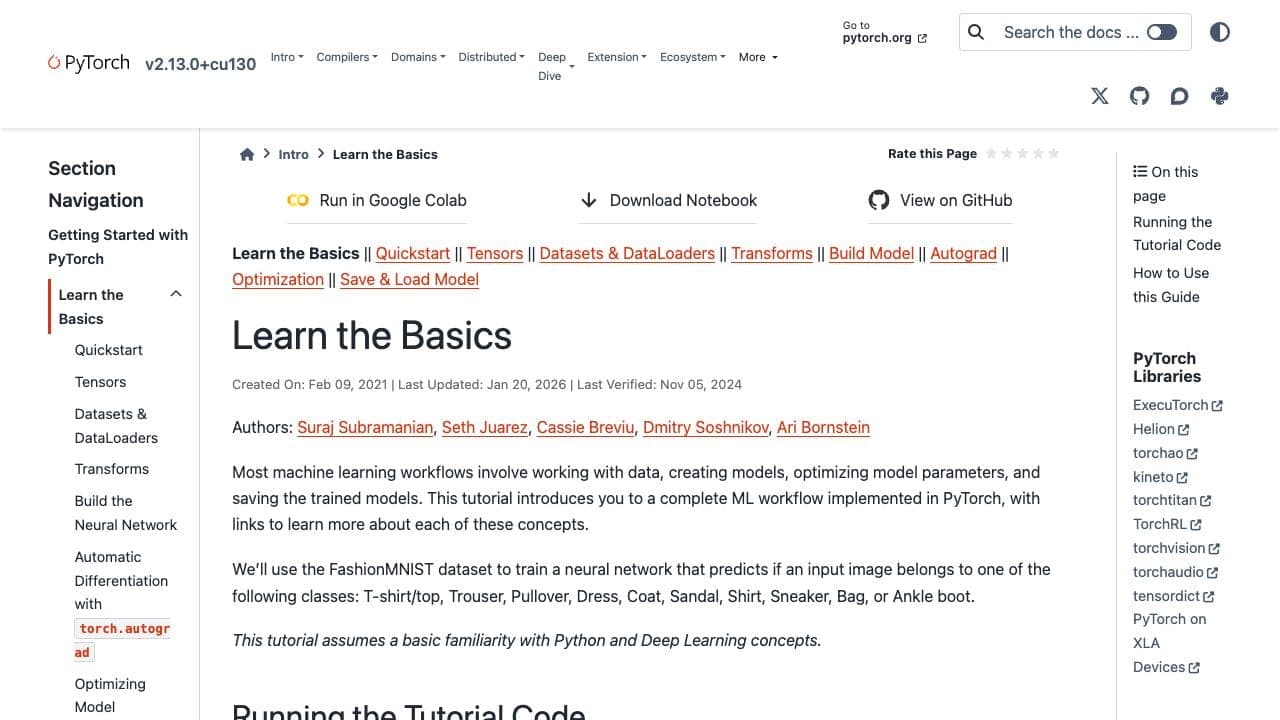
Learn the Basics with PyTorch by PyTorch
Hands-on labBeginner

Learn the Basics with PyTorch

PyTorch

An end-to-end quickstart through tensors, datasets, transforms, model construction, automatic differentiation, optimization, and saving a trained model.

Time
Nine-step quickstart
PyTorchtraining loopautograd
Read the ToolDix guide
TensorFlow Tutorials by TensorFlow
Hands-on labBeginner

TensorFlow Tutorials

TensorFlow

Official notebook tutorials for beginner workflows, data loading, Keras models, vision, text, structured data, and distributed training.

Time
Notebook collection
TensorFlowKerasnotebooks
Read the ToolDix guide
MIT Introduction to Deep Learning by MIT 6.S191
Video seriesIntermediate

MIT Introduction to Deep Learning

MIT 6.S191

A concise university course covering deep-learning foundations, sequence models, generative models, reinforcement learning, and current applications.

Time
Annual lecture series and labs
deep learninglectureslabs
Read the ToolDix guide
CS50's Introduction to AI with Python by Harvard University
CourseIntermediate

CS50's Introduction to AI with Python

Harvard University · Brian Yu and David J. Malan

A project-led introduction to search, knowledge representation, uncertainty, optimization, machine learning, neural networks, and language in Python.

Time
7 topics · lectures and projects
Author
Brian Yu and David J. Malan
searchmachine learningneural networks
Read the ToolDix guide
LlamaFactory Getting Started by LlamaFactory
Hands-on labAdvanced

LlamaFactory Getting Started

LlamaFactory

A practical entry point for supervised fine-tuning, preference optimization, multimodal models, dataset configuration, evaluation, inference, and export across many model families.

Time
Setup · data · training · evaluation
fine-tuningdataset formattingevaluation
Read the ToolDix guide